Structure & Phase Institute

Breaking Research Deadlocks via SPI Insight

  • Why LLMs Answer Too Quickly

    We often explain LLM failures in terms of hallucination or missing data.
    But in practice, many failures do not begin with wrong answers.

    They begin with answers that arrive too early.

    The moment an LLM receives a question,
    it often starts moving toward a conclusion
    before the problem itself has been properly structured.

    This is what I call a Deadlock.

    Comparisons repeat.
    Assumptions blur.
    Value conflicts remain unresolved.
    Text continues to be generated,
    but reasoning no longer advances.

    This is not a lack of intelligence.
    It is a lack of reasoning structure.


    It Was Never About the Question

    Most prompting techniques focus on
    how to explain a question more clearly.

    But what repeatedly surfaced in my research
    was that the core problem was not explanation,
    but the absence of phases through which thinking should move.

    Reasoning is not instantaneous.

    It defines concepts,
    reveals relations,
    checks structural consistency,
    and only then shifts perspective.

    When this phase transition is skipped,
    LLMs produce fluent language
    instead of genuine reasoning.


    Why C-Frame Delays the Answer

    This week, I released the C-Frame Reasoning Core on GitHub.

    C-Frame is deliberately designed
    to prevent immediate answers.

    It forces the model to:

    • structure the problem first,
    • move reasoning through explicit phases,
    • and advance only when each phase is completed.

    C-Frame does not tell LLMs to “think harder.”
    It tells them to think in motion.


    Deadlock Is Not an Error

    Deadlock is not something to eliminate.
    It is something to expose.

    Where reasoning stalls,
    there is always a structural reason.

    C-Frame makes this visible
    and allows reasoning to move again from that point.


    What This Release Means

    This GitHub release is not about offering solutions.

    It is about fixing the existence of an engine—
    an engine for reasoning that moves by structure and phase,
    not by speed.

    That is the core message of DeadLock Insight #5.

    🔗 C-Frame Reasoning Core (GitHub)
    https://github.com/Kimsangsoo033/cframe-reasoning-core/blob/main/README.md
  • We often blame LLMs for hallucinations and shallow reasoning.
    But in most real cases, the problem is not missing knowledge —
    it is poorly structured questions.

    LLMs are optimized for fast responses, not for slow, phase-based thinking.
    So they repeat comparisons, hide uncertainty, and jump to conclusions.

    I’ve released C-Frame, a small reasoning framework
    that forces problems to be structured first and reasoning to move in phases.

    C-Frame schemas and examples are now publicly available on GitHub.
    https://github.com/Kimsangsoo033/cframe-reasoning-core/blob/main/README.md

  • Why Creativity Always Appears at the Edge of Order

    We often describe creativity as freedom.
    As if new ideas emerge most easily when all constraints are removed.

    But this intuition rarely holds.

    In spaces where rules are entirely absent,
    it becomes difficult to distinguish what is new from what is merely random.
    Without structure, novelty loses its contrast.
    Everything happens, yet nothing stands out.

    At the opposite extreme,
    in systems governed by rigid and exhaustive rules,
    variation is discouraged before it can even take shape.
    Change becomes an error rather than a possibility.

    Creativity does not thrive at either end.

    It appears in between—
    at the edge where order still functions,
    but no longer fully sustains itself.

    This is a fragile region.
    The system has not collapsed,
    yet it can no longer rely on its existing language alone.
    Old explanations still work, but only partially.
    Old structures still stand, but no longer feel sufficient.

    This edge is uncomfortable.
    Unstable. Ambiguous.
    It constantly raises a quiet but persistent question:
    Is this still acceptable?

    Because of this discomfort,
    many systems instinctively avoid the edge.
    They retreat toward safety, reinforcing existing rules.
    Or they leap into chaos, abandoning structure altogether.

    Both choices feel easier than staying.

    Yet meaningful change happens only here—
    where the language of order is still intelligible,
    and its limitations become visible for the first time.

    Creativity does not emerge from silence.
    It emerges from the realization that existing words,
    though still functional, are no longer enough.

    In this sense, creativity is rarely an act of rebellion.
    It is closer to a signal.
    A sign that order itself is struggling to renew,
    searching for a way to remain coherent without becoming rigid.

    Perhaps creativity is not the enemy of order.
    Perhaps it is order’s final attempt to save itself
    before collapse or stagnation sets in.

    So the question remains:

    Is creativity a force that breaks order?
    Or is it the moment when order recognizes
    that it must change in order to survive?

    #ThursdayColumn#Creativity#EdgeOfOrder#AIandHumanity#ThinkingInTheAgeOfAI

    #SystemsThinking#Complexity#PhilosophyOfTechnology#AIethics#QuietThinking

  • People say:

    “The temperature suddenly spiked.”
    “Voltage was stable—why did it explode?”

    But thermal runaway is never sudden.
    It only looks sudden because we view the wrong signal.

    The explosion is the last sign, not the first.


    1. Thermal runaway is a time-domain collapse

    Before the temperature shoots up:

    • topology has already shifted
    • spectral patterns have broken down
    • the BMS meaning-frame has drifted

    Temperature is simply the final reaction.


    2. Why we fail to see early warnings

    ✔ Sensors only measure the “surface”

    But instability starts deep inside:

    • micro cracks
    • SEI layer failure
    • local hotspots
    • micro short circuits

    All invisible to external sensors.


    ✔ Patterns collapse before numbers do

    Voltage can look stable even when
    spectral coherence is breaking internally.

    • hidden noise rise
    • band drift
    • coherence loss

    All occur long before temperature increases.


    ✔ BMS is interpreting with the wrong model

    It assumes:

    “Stable voltage → Stable battery”

    But when the internal structure changes,
    this interpretation becomes wrong while still appearing correct.

    This is the true deadlock.


    3. The real warning sign is the plateau

    Just before runaway,
    the temperature often becomes strangely flat.

    This plateau means:

    • topology is reorganizing
    • new current paths are forming
    • hotspots are forming
    • the system is losing coherence

    Calmness before collapse.


    4. The challenge is not “more sensors”

    It’s a perspective problem, not a hardware problem.

    Thermal runaway follows:

    Topology → Spectrum → Meaning → Time

    Sensors measure only the last part: Time.

    We must read all four layers.


    5. Horizon Shift: the correct way forward

    Predicting thermal runaway becomes possible only when
    we stop looking at the surface
    and start reading:

    • structure
    • patterns
    • meaning
    • time

    in the correct order.


    6. Conclusion

    Thermal runaway is not sudden.
    It is the final chapter of a long structural collapse
    we simply failed to see.

    Next week:
    Why BMS loses its semantic reference frame—and how to detect it early.

    #BMS #BatterySafety #SemanticReferenceFrame#DeadlockInsight #EarlyWarningSignals

    #SystemStability #FailureDiagnosis#EngineeringAI #StructurePhaseInstitute

  • **The world shakes in a sequence:

    Topology → Pattern → Meaning → Time.**

    This week, we explore the final layer: Temporal Stability
    why time-domain signals react last,
    and why their instability is often the most dramatic.


    1. Time-domain data shows only the result of deeper changes

    When we see:

    • sudden vibration spikes
    • sudden temperature jumps
    • sudden heart-rate fluctuation
    • sudden price volatility

    we assume it’s the beginning of a problem.

    But temporally,
    these are the end of a longer process.

    Before time reacts:

    • topology was already shifting,
    • patterns were already collapsing,
    • meaning structures were already drifting.

    2. Why the time-domain responds last

    ✔ It’s a result variable

    It reflects cumulative internal stress.

    ✔ It’s insensitive to subtle structural changes

    Forms and patterns shift long before values explode.

    ✔ Meaning collapses before time-series becomes chaotic

    We interpret incorrectly before numbers visibly change.


    3. Real-world deadlocks

    ✔ Battery thermal runaway

    The temperature explosion is the final stage,
    not the first.

    ✔ Heart-rate variability (HRV) breakdown

    The chaotic signal appears
    after long structural instability in the nervous system.

    ✔ Financial volatility spikes

    Price chaos follows network reconfiguration
    and meaning-frame breakdown.


    4. Why time-series often mislead us

    Because they are:

    • easiest to measure
    • most intuitive
    • most visual

    But these are illusions.

    Time-series instability appears last.
    It is the result, not the cause.


    5. How to correctly read temporal stability

    • Look at rate of change, not just value
    • Combine topology, spectrum, and meaning
    • Focus on plateaus as early warnings
      (systems often go quiet before they break)

    6. Conclusion

    Temporal instability is the final symptom
    of a long chain of structural shifts.

    Next Sunday, we’ll explore real-world examples
    of how time-domain failure appears in engineering and biology.

    #TemporalStability #DeadlockInsight #HorizonShift#Topology #PatternCollapse #MeaningDrift

    #SystemDynamics #EarlyWarningSignals#EngineeringInsights #ScientificThinking

    #StructurePhaseInstitute

  • **“We collected temperature, humidity, pressure, vibration…

    Why can’t AI find the defect cause?”**

    This is one of the most common failures in modern factories.

    And it is a classic deadlock.


    1. Even massive data fails if the topology is wrong

    The real early signs of failure often appear as:

    • cluster splitting
    • loop disappearance
    • local density collapse

    These are topological events
    not statistical correlations.

    ML models rarely detect them.

    So the system stays blind.


    2. Spectral collapse is the second warning — but AI doesn’t “hear” it

    Even when numeric values stay normal:

    • coherence collapses
    • frequency bands drift
    • energy spreads

    Spectral instability is often the true precursor,
    but typical AI treats spectra as static numbers/images.

    It does not understand structural decay.


    3. The biggest problem — no semantic frame

    AI does not know:

    • which variable is cause
    • which is effect
    • which is noise
    • which represents physical law

    Without this ontology,
    pattern recognition becomes meaningless correlation hunting.


    4. Case Studies

    ✔ Semiconductor

    Clusters split subtly before failure;
    coherence collapses.

    ✔ Battery cell manufacturing

    A stable loop in feature space suddenly disappears—
    an early topological crack.

    ✔ Motor assembly

    Numerical values same;
    spectral structure completely different.


    5. How to break the deadlock

    True analysis follows the order:

    Topology → Spectrum → Ontology

    Not the other way around.


    6. Conclusion

    It’s not a data problem.
    It’s a perspective problem.

    #DeadlockInsight #ManufacturingAI #RootCauseAnalysis#Topology #SpectrumAnalysis #CoherenceCollapse#IndustrialAI #FailureAnalysis #AIinManufacturing#Ontology #ScientificThinking #StructurePhaseInstitute

  • **Patterns alone cannot explain the world.

    Meaning requires structure.**

    In the past two weeks, we explored how
    the world first shifts in topology and then in spectrum.

    But even if we know all the patterns,
    we still don’t “understand” the world.

    Understanding requires meaning,
    and meaning requires a reference frame.

    This reference frame is what we call ontology.


    1. Meaning does not arise from data. It arises from structure.

    When we interpret the world, we don’t just see information—we connect it.

    • “This is a cat.”
    • “That’s a danger signal.”
    • “This pattern is normal; that one isn’t.”

    These judgments depend on an underlying semantic structure.

    Without a semantic frame, patterns are just… dots.


    2. Everyday ontology (though we rarely notice it)

    Examples:

    ✔ Hospitals

    MRI brightness means nothing
    without the ontology of brain anatomy.

    ✔ Vehicle noise

    Engineers classify noise by type—
    without ontology, FFT is meaningless.

    ✔ AI

    Language models must map patterns into a semantic network
    to answer anything coherently.

    ✔ Cooking

    Ingredients mean nothing without
    a structure of roles and relationships.

    We all use ontology every day.


    3. Why patterns alone cannot create meaning

    Patterns are unstable, context-dependent, and ambiguous.

    • Similar vibration → different causes
    • Similar text → opposite meanings
    • Similar melody → different genres

    Pattern ≠ meaning.
    Meaning is created by mapping patterns onto a structured frame.


    4. Ontology is the “map of explanation”

    Ontology provides:

    1. categories
    2. relationships
    3. context
    4. constraints

    Without these, information remains fragmented.


    5. Why ontology is returning in the age of AI

    Large models generate impressive patterns,
    but often fail at meaning:

    • hallucinations
    • semantic drift
    • inconsistent reasoning

    The root cause:

    The model lacks a stable semantic reference frame.

    This is why modern AI research is bringing back
    ontology, symbolic structure, and concept alignment.


    6. Conclusion — Building a semantic coordinate system

    Topology → Spectrum → Ontology

    Meaning arises only when patterns
    are placed within a stable reference frame.

    Next week’s topic:
    Time — the final signal that reveals instability.

    #Ontology #MeaningMaking #SemanticStructure

    #DeadlockInsight #HorizonShift #PatternVsMeaning

    #ScientificThinking #AIReasoning #StructurePhaseInstitute

    #Topology #Spectrum #SemanticReferenceFrame

  • The truth about Coherence Collapse**

    You’ve probably experienced this:

    Your car feels noisy.
    You take it to the shop.
    They measure it and say: “Everything looks normal.”

    But your ears say otherwise.

    The same thing happens with refrigerators, air conditioners, fans, and computers.

    Today’s insight begins with one question:

    Why do humans detect discomfort that machines cannot?


    1. It’s not the volume. It’s the pattern.

    Most machines measure “how loud” something is.
    But the human body detects pattern first, loudness second.

    When the pattern breaks—even slightly—
    the sound feels unpleasant, even if the volume is unchanged.

    This pattern breakdown is known as
    coherence collapse.


    2. Tiny structural changes ruin the pattern

    Examples:

    ✔ A car door misaligned by 0.1 mm

    Machine: normal
    Human: “Something feels wrong.”

    ✔ A refrigerator hums loudly only at certain moments

    A small bolt loosened → pattern distortion

    ✔ A strange echo in a meeting room

    A panel is tilted by just 1 cm → pattern collapse

    ✔ A laptop fan suddenly sounds harsh

    A tiny blade deformation → coherence disappears

    Common theme:

    Pattern is fragile. Tiny changes destroy it.


    3. Why humans detect it better than sensors

    Sensors look at amplitude.
    Humans detect:

    • phase
    • coherence
    • rhythm smoothness

    We are built to sense pattern stability.
    Machines often miss this entirely.


    4. Why this deadlock matters

    When coherence collapses:

    • sensors say “no issue,”
    • people feel discomfort,
    • root cause is hard to find,
    • and real failure may follow later.

    Coherence collapse is the first warning sign.


    5. How to notice it in daily life

    You can detect coherence problems if:

    • the noise appears only at certain speeds,
    • only in certain rooms or angles,
    • only at certain times,
    • or if the sound “feels messy” even when not loud.

    These are classic symptoms of pattern collapse.


    ✔ Conclusion

    Uncomfortable sounds aren’t about loudness.
    They are about broken patterns
    the earliest signal that something deeper is changing.

    #CoherenceCollapse #SpectralAnalysis #PatternStability

    #AcousticEngineering #Vibration #ModalAnalysis

    #PhaseStability #SignalIntegrity #TDA #SPI

    #EngineeringDiagnostics #PredictiveMaintenance

  • The world speaks in patterns, not just numbers.

    If Topology is the skeleton of a system, then Spectrum is its native rhythm—its energy signature.

    Across physics, neuroscience, acoustics, AI, materials, and finance, we interpret the world fundamentally through patterns. And the universal truth is this: When these patterns collapse, interpretation collapses with them.

    1. Spectrum is a System’s “Energy Fingerprint”

    Every existing system possesses a unique frequency signature:

    • The resonance of a wine glass.
    • The eigenmodes of a skyscraper.
    • The alpha–gamma rhythms in the human brain.
    • The attention frequency in Large Language Models (LLMs).

    This leads to a core principle of Strategic Stability Theory (SST): “When structure shifts, patterns collapse first.”

    2. Pattern Collapse Reacts to Even Tiny Structural Perturbations

    Patterns are hypersensitive to structural changes. They act as the most delicate sensor.

    ✦ Example 1: Coherence Collapse in Vehicle Acoustics Consider a vehicle chassis. A structural deviation of just 0.2 mm—invisible to the naked eye—can cause significant acoustic issues. While the raw FFT (Fast Fourier Transform) values might appear within the “normal range,” the driver instantly detects unpleasant “Booming Noise” or “Roughness.” The structure shifted slightly, but the spectral coherence dropped drastically.

    ✦ Example 2: Out-of-tune Musical Harmony If a single piano string is stretched minutely, the phase relationship between its partials breaks. A digital tuner might show the fundamental pitch is “close enough,” but the human ear detects immediate dissonance. The phase alignment—the hidden pattern—is gone.

    ✦ Example 3: Attention Spectral Collapse in AI In AI, when data distribution shifts, the attention heads in the model exhibit band instability. This spectral noise is the precursor to hallucination and reasoning drift.

    3. Why Does Spectrum Collapse First? (The Leverage Effect)

    Why do we hear the noise before the machine breaks? It is due to a Leverage Effect.

    Topology moves by 1 unit → Spectrum reacts by 10.

    Spectrum acts as a magnifier. It amplifies deep, hidden structural flaws into observable vibrations. A micro-crack in the topology manifests as a screaming noise in the spectrum. This amplification makes Spectrum the most reliable early-warning system.

    4. The Sequence of Collapse

    The world does not fail all at once. It follows a strict sequence:

    1. Topology Shift (Internal structure cracks)
    2. Spectral Collapse (Pattern becomes incoherent) 🚨 <– Early Warning
    3. Semantic Loss (Meaning and trust fail)
    4. Phenomenal Crash (The actual event/disaster occurs)

    Spectrum is the second point of failure, but it is the first observable signal. Whether it is predicting arrhythmia, battery thermal runaway, or market volatility, reading the spectrum means seeing the future before it manifests in the time domain.

    Conclusion

    The world does not communicate through static numbers. It communicates through living patterns.

    If Topology is the shape of the world, Spectrum is its pulse.

    If the pulse becomes irregular, the collapse of meaning is imminent.

    Next Week: Ontology — The semantic frame built on top of patterns.

    #SST #Spectrum #SignalProcessing #Vibration #AI #StrategicStability #EarlyWarning #StructurePhase

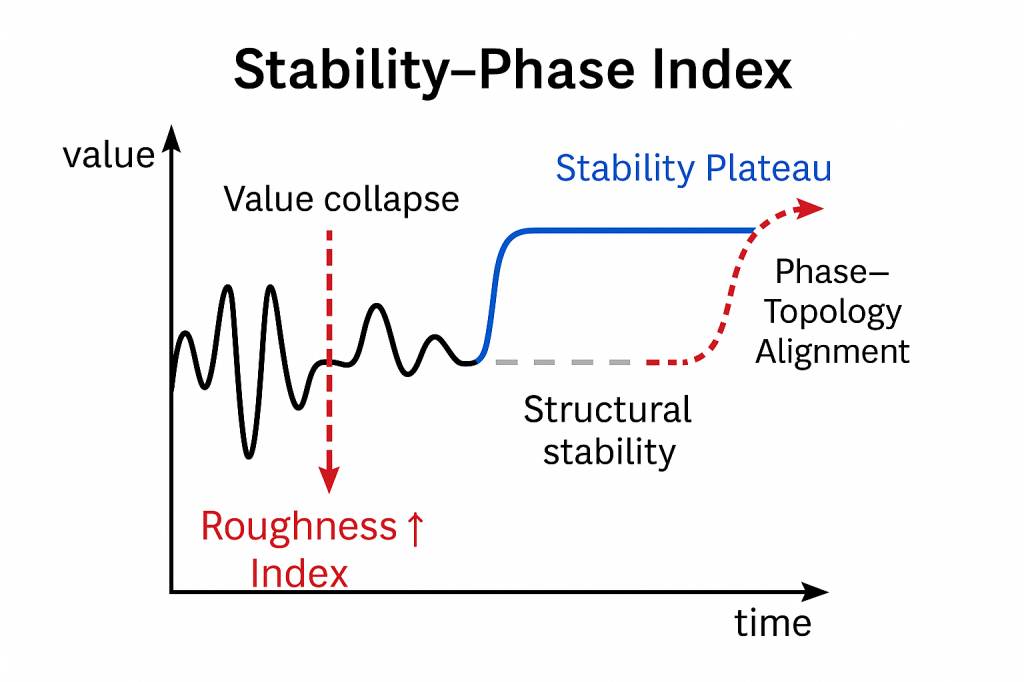
  • — Why Everything Looks Normal Until a Hidden Phase Appears
    (Stability–Phase Index Perspective)

    Some materials look perfectly normal as insulators—
    the conductivity, gap size, and band diagrams all say “nothing special.”
    And yet, they behave as if a new phase is quietly emerging underneath.

    This is the classic Excitonic Insulator Deadlock.

    Researchers often ask:

    “All the values look fine.
    So why is this material acting strangely?”

    Because the transition is not a value problem.
    It is a stability–structure problem.


    🔵 1. Value-based diagnostics cannot reveal the transition

    Excitonic condensation does not announce itself through
    resistivity, band gaps, or raw numerical parameters.

    It appears as a pattern of stability that unfolds over time:

    • fluctuations →
    • temporary stability →
    • structural reorganization →
    • new phase topology

    If you only look at values, the transition remains invisible.


    🔵 2. Stability–Phase Index reveals the structure

    SPI tracks three core patterns:

    ① Roughness Zone

    The system fluctuates heavily—no stable state yet.

    ② Stability Plateau

    A coherent pattern appears; a state is formed.

    ③ Phase–Topology Alignment

    The key moment where the system shifts into a new phase.

    An Excitonic Insulator follows this exact sequence.
    The plateau and transition point mark the hidden reorganization
    that conventional measurements fail to capture.


    A lake does not “gradually” freeze in value terms.
    Temperature tells you very little.

    Instead:

    🔵 3. A simple analogy: a lake freezing

    1. micro-fluctuations happen near freezing,
    2. a thin stable sheet of ice appears (plateau),
    3. the whole lake suddenly transitions into a solid phase.

    Excitonic condensation behaves the same way.

    Values hide it.
    Stability patterns reveal it.


    🔵 4. Why this solves the Deadlock

    The key principle of S&PI is:

    What values hide, structure reveals.

    Most failures in modeling, experiments, reproducibility,
    and interpretation arise because the problem is framed in terms of “values.”

    Once the perspective shifts to stability, topology, phase,
    the hidden transition becomes obvious.